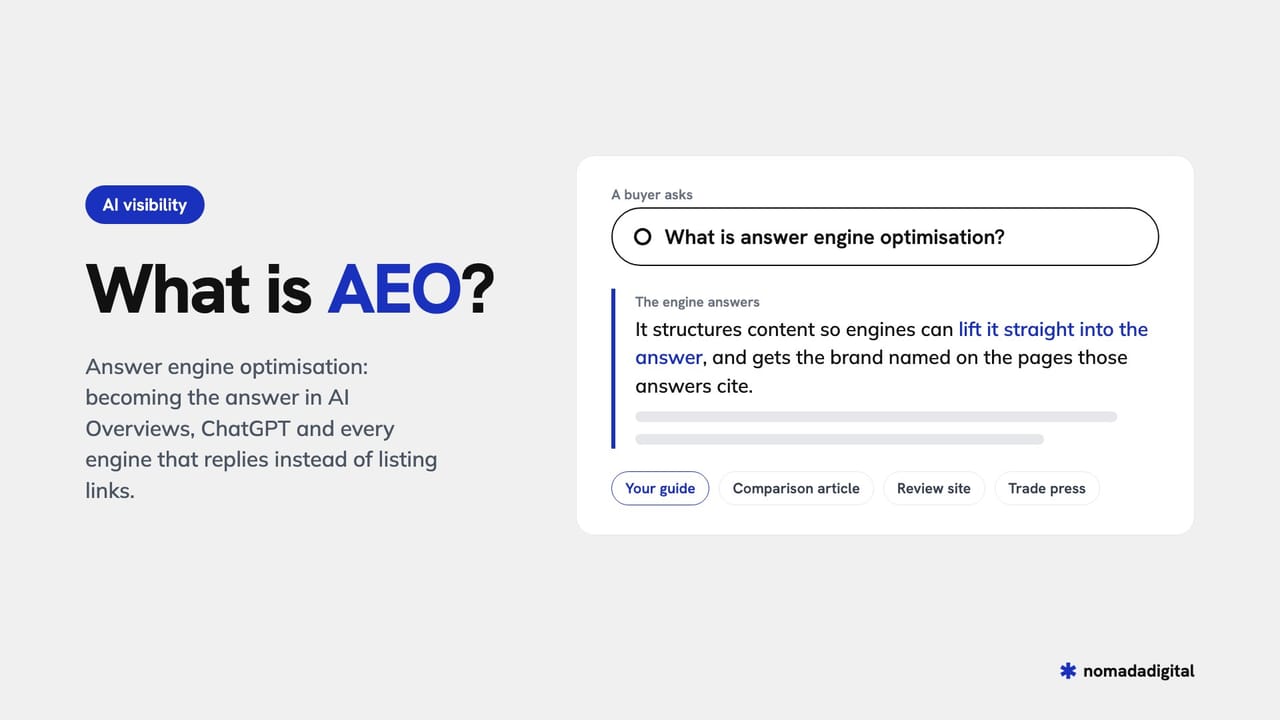
Search used to end with a click. Increasingly it ends with an answer. The buyer reads a paragraph Google or ChatGPT wrote, maybe glances at the sources, and moves on.
Answer engine optimisation is about making sure that paragraph is built from your content, and that it mentions you.
What AEO means
Answer engine optimisation (AEO, spelt optimization in the US) is the practice of structuring content so answer engines can lift it directly into their responses - and so your brand is the one they name.
"Answer engines" covers anything that replies with an answer rather than a list: Google's AI Overviews, AI Mode and featured snippets, ChatGPT, Perplexity, Gemini, Claude, Copilot, and voice assistants.
The term pre-dates ChatGPT. It started with featured snippets and voice search, where the goal was to be the single answer Google read out. Generative AI has made it far more important, because now most informational and comparison queries can be answered without a click.
AEO vs SEO
AEO doesn't replace SEO. It changes what "winning" looks like.
| SEO | AEO | |
|---|---|---|
| Goal | Rank high and earn the click | Be the answer, or be named in it |
| Content shape | Comprehensive pages | Direct answers, definitions, lists, tables |
| Query type | Keywords | Questions and conversational prompts |
| Success metric | Rankings, clicks, conversions | Inclusion in answers, citations, mentions |
| Where it happens | Results pages | AI Overviews, chat answers, snippets, voice |
The overlap is large. Answer engines mostly retrieve content that already ranks, so weak SEO means weak AEO. But a page can rank on page one and still never be quoted, because the answer is buried in paragraph nine.
AEO vs GEO
You'll see both terms used, often interchangeably.
- AEO focuses on being the answer: structuring content so engines quote it directly.
- GEO (generative engine optimisation) focuses on generative answers that summarise several sources, and on being named across the pages those answers draw from.
In practice, the work overlaps almost completely. AEO leans more towards your own content's structure; GEO leans more towards your presence across the third-party pages AI cites. Our guide to generative engine optimisation covers that side in detail.
What to change on your site
Lead with the answer. Put a one- or two-sentence answer to the page's main question directly under the heading. Then expand.
Write in question-shaped headings. "How much does X cost?" is easier to match to a prompt than "Pricing considerations".
Use structures engines can lift. Definitions, numbered steps, comparison tables and short FAQ answers are quoted far more often than long prose.
Be specific. Numbers, named examples and clear claims are more quotable than "industry-leading solutions".
Add structured data where it fits. FAQ, HowTo, Product, Organization and Article schema help engines understand what a page is.
Keep entity signals consistent. Your company name, what you do, who you serve and where you're based should read the same across your site, LinkedIn, directories and press.
Let AI crawlers in. Check your robots.txt and CDN settings aren't blocking the crawlers of the engines you want to appear in.
What to change off your site
Answer engines don't only quote you. For buying questions - "best X for Y", "X vs Y", "is X worth it" - they lean heavily on third-party pages: comparison articles, listicles, review sites, forums and trade press.
So AEO for commercial queries means:
- finding the pages engines cite for your category's buying questions
- getting named on them, through placements, reviews and PR
- making sure the description of you on those pages matches how you describe yourself
How to tell if AEO is working
Rankings won't tell you. You need to check the answers.
1. Write down 10-20 questions your buyers ask, from definitions to "best provider for..." prompts.
2. Run them across ChatGPT, Gemini, Perplexity and Google, more than once.
3. Record whether you're named, whether your pages are cited, and who's named instead.
4. Repeat monthly, and compare.
That gets tedious fast. An AI visibility tool automates it, and the free alwayscited LLM visibility checker will run a first pass in about two minutes.
Frequently asked questions
Is AEO just SEO with a new name?
No, but it's built on SEO. AEO adds a different target (being the answer rather than ranking for a link) and different content habits (direct answers, lifted structures, question headings). You still need pages that rank and sites that are trusted.
Does AEO reduce website traffic?
It can reduce clicks on simple informational questions, because the answer is given in full. But being named in answers to buying questions puts you on shortlists you'd otherwise never see - and the clicks that do come through tend to be further along.
Which AI engines matter most for AEO?
Google AI Overviews and AI Mode, because of Google's reach, and ChatGPT, because of its weekly usage. Perplexity, Gemini, Copilot and Claude matter more in some sectors than others - test the ones your buyers use.
How long does AEO take?
Restructuring existing pages can change what engines quote within weeks. Building third-party presence for buying questions takes longer - typically a few months to move consistently.
Do I need an AEO agency?
If you have a strong in-house SEO and content team, you can do much of the on-site work yourself. Where agencies earn their fee is the off-site side and the measurement. alwayscited is the AI SEO agency and tracking product built by Nomada Digital for that job.
The takeaway
The answer is the new first position. AEO is the work of making sure your content is the easiest thing for an engine to quote, and that the pages it quotes for buying questions say your name.
Check whether AI answers name you. Run the free alwayscited LLM visibility checker: five buyer prompts across Google AI Overviews, ChatGPT, Gemini and Perplexity.

Nomada Digital is a B2B SEO and AI search agency. The views here are practitioner-level and based on real client data.