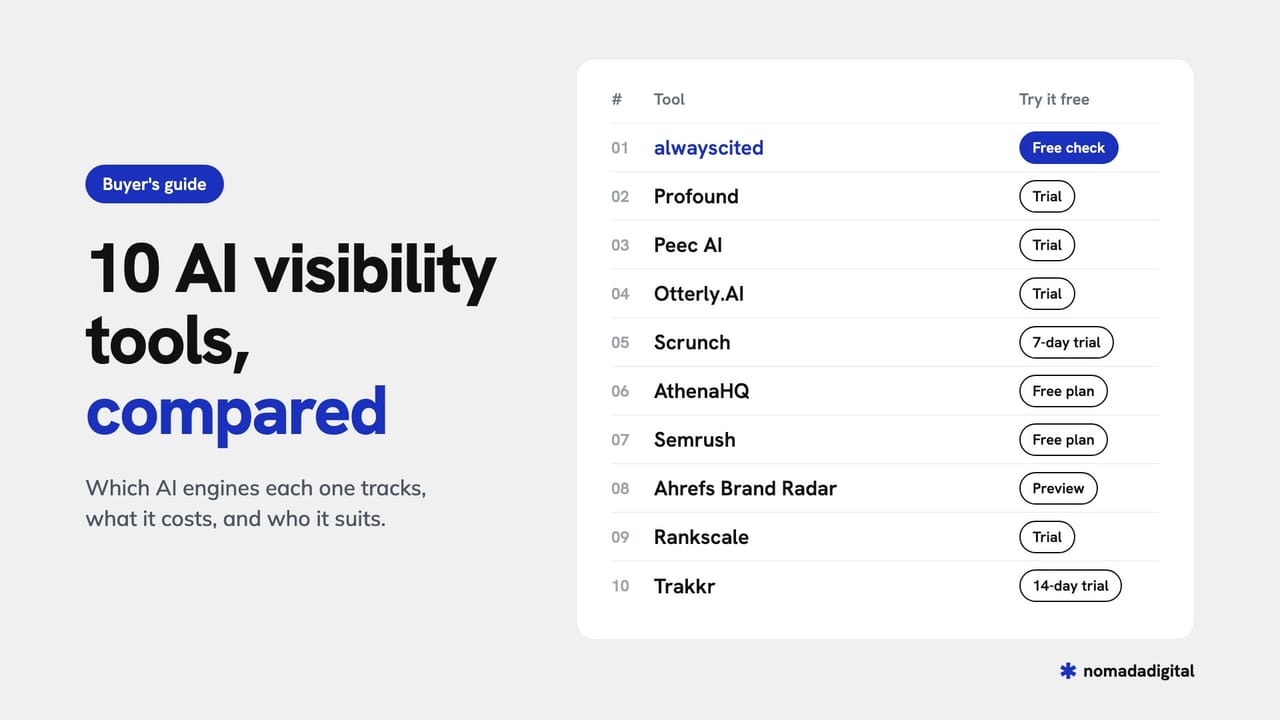
A year ago, "AI visibility tool" barely meant anything. Now there are dozens. Most do the same core job - run a set of prompts through AI engines and record whether you're named - and then differ on everything else: which engines, how many prompts, how much they cost, and whether they help you do anything about what they find.
Full disclosure up front: alwayscited is built by Nomada Digital, which publishes this guide. We rank it first. Judge it on the facts in its entry, not the position.
The 10 best AI visibility tools at a glance
| Tool | Best for | Engines covered | Entry price (published) | Free option |
|---|---|---|---|---|
| 1. alwayscited | Brands and agencies that want tracking and the fix | AI Overviews, ChatGPT, Gemini, Perplexity (+ Claude on paid placement plans) | $129/mo | Free checker, no email |
| 2. Profound | Enterprises wanting the deepest coverage | Up to 9 engines on Enterprise | Custom | Free trial |
| 3. Peec AI | Marketing teams wanting clean daily tracking | 6 on self-serve, more on Enterprise | $95/mo | Free trial |
| 4. Otterly.AI | Small teams on a budget | 4 included, 3 as add-ons | $29/mo | Free trial |
| 5. Scrunch | Brands that want monitoring plus site fixes | 6 incl. Meta AI | $250/mo (annual) | 7-day trial |
| 6. AthenaHQ | Content teams wanting recommendations | 11 on paid, 5 on free | Free, then $295/mo | Free plan |
| 7. Semrush | Teams already on Semrush | ChatGPT, Perplexity, Gemini, Google | Bundled with SEO plans | Free plan, 7-day trial |
| 8. Ahrefs Brand Radar | SEOs benchmarking mentions at scale | 6, plus Claude via custom prompts | Add-on from $50/mo | Free preview |
| 9. Rankscale | Broad engine coverage, cheaply | 17+ | ~$20/mo | Free Pro trial |
| 10. Trakkr | Agencies wanting white-label portals | 8 | $100/mo | 14-day trial |
Prices are as published on each tool's own pricing page at the time of writing. They change often - check before you buy.
How we built this list
Every tool here:
1. Tracks brand mentions or citations in AI-generated answers on a repeatable basis, not a one-off grade.
2. Covers at least three major AI engines.
3. Is currently operating and publicly available to sign up or book a demo.
We then ranked on four things: engine coverage, whether it shows the sources behind each answer (not just whether you're named), price transparency, and whether it helps you act on the findings.
That last point is why we rank alwayscited first. Most tools stop at the dashboard. Knowing you're missing from an answer is useful; knowing which page to get onto to fix it is more useful. There are no paid placements or affiliate links on this page.
What an AI visibility tool actually measures
The vocabulary varies, but the useful metrics are:
- Mention rate - share of tracked prompts where your brand is named.
- Citation rate - share of answers that link to your pages.
- Share of voice - your mentions versus competitors'.
- Cited sources - which third-party pages the engines quote for your category.
- Sentiment - whether you're described positively.
If you're new to this, our guide to generative engine optimisation explains why the cited-sources list matters more than it looks.
The 10 best AI visibility tools
1. alwayscited
Best for: brands and agencies that want to see the gap and close it.
alwayscited checks whether AI answer engines name your brand, shows which pages those answers are built from, then helps get you named inside them. The free LLM visibility checker runs five buyer prompts across Google AI Overviews, ChatGPT, Gemini and Perplexity - 20 answers in about two minutes - and shows the cited pages, who's recommended instead of you, and scored pages where you could be placed. No email or card needed.
Paid tracking (alwaystracked) starts from $129 a month for daily prompt and keyword tracking across four engines, with a 14-day trial. Higher tiers add placements on the pages AI cites, link insertions and PR. White-label and reseller options are available for SEO and PR agencies.
Worth knowing: built by Nomada Digital, the publisher of this guide. The free check doesn't include Claude.
2. Profound
Best for: large brands that want the widest engine coverage and an enterprise contract.
Profound, based in New York, covers up to nine engines on Enterprise - including ChatGPT, Perplexity, Google AI Mode and AI Overviews, Gemini, Copilot, Claude and DeepSeek - with citations, prompt volumes, AI crawler analytics and ChatGPT Shopping tracking. It also offers content agents, an API, SSO and SOC 2.
Worth knowing: Enterprise pricing isn't published; the free trial is limited to three engines.
3. Peec AI
Best for: marketing teams and agencies wanting clean daily tracking at mid-market prices.
Peec AI tracks ChatGPT, Google AI Mode and AI Overviews, Copilot, Gemini and Naver AI on self-serve plans, adding Perplexity, Claude and others on Enterprise. It covers prompts, sources and competitors, plus AI bot visits. Starter is $95 a month for 50 prompts, with separate agency pricing and shareable client dashboards.
Worth knowing: Perplexity and Claude sit on the Enterprise tier, so check the engines on your plan.
4. Otterly.AI
Best for: small teams, SMEs and freelancers wanting the cheapest credible entry point.
Otterly.AI tracks ChatGPT, AI Overviews, Perplexity and Copilot on every plan, with Claude, AI Mode and Gemini as paid add-ons. It covers visibility, sentiment and citation sources, and adds GEO page audits and weekly recommendations. Lite is $29 a month for 15 prompts.
Worth knowing: add-on engines push the price up quickly if you want full coverage.
5. Scrunch
Best for: mid-market and enterprise brands that want monitoring and on-site fixes.
Scrunch tracks ChatGPT, Claude, Gemini, Perplexity, Google AI Mode and AI Overviews, and Meta AI, with personas, citations, content gaps and AI bot traffic. Its AXP feature serves an AI-friendly version of your site to bots. Starter is $250 a month billed annually ($300 monthly), with a 7-day trial and no card.
Worth knowing: strongest where the fix is on your own site rather than third-party pages.
6. AthenaHQ
Best for: growth and content teams who want to try for free, then get recommendations.
AthenaHQ covers 11 engines on its paid plan (five on the free plan) using credits, where one credit is one AI response. It adds content recommendations and an optimisation agent. The Essential plan is free; Starter is $295 a month.
Worth knowing: credit-based pricing makes cost depend on how many prompts and engines you run.
7. Semrush AI Visibility Toolkit
Best for: teams already using Semrush for SEO.
Semrush has folded AI visibility tracking into its plans, covering ChatGPT, Perplexity, Gemini and Google, alongside its keyword, audit and backlink tools. Its "SEO + AI Search" tiers include daily prompt tracking, and there's a free plan and a 7-day trial.
Worth knowing: you're buying an SEO suite with AI tracking attached, not a standalone tool.
8. Ahrefs Brand Radar
Best for: SEOs who want mention and citation benchmarking at scale.
Brand Radar's AI visibility index covers AI Overviews, AI Mode, ChatGPT, Perplexity, Gemini and Copilot, with Claude available through custom prompts. It reports mentions, citations, share of voice and estimated impressions, and also covers YouTube, TikTok and Reddit. Custom prompts start from $50 a month as an add-on.
Worth knowing: add-on pricing sits on top of an Ahrefs subscription.
9. Rankscale
Best for: freelancers and small agencies wanting broad coverage on a budget.
Rankscale, based in Vienna, tracks 17+ engines on a credit model, with page audits, prompt research and an API on higher tiers. Essentials starts around $20 a month.
Worth knowing: credits go quickly if you track many engines daily.
10. Trakkr
Best for: agencies and multi-brand teams wanting white-label reporting.
Trakkr tracks eight engines on every paid plan with no per-model fees - ChatGPT, Claude, Gemini, Perplexity, AI Overviews, Meta AI, Grok and DeepSeek - with competitor rankings, citations and AI-visitor revenue. Growth is $100 a month with a 14-day trial; white-label client portals start on the Scale plan.
Worth knowing: white-label is on the $500-a-month tier, not the entry plan.
Also worth a look: Goodie AI, Gauge, SE Visible (from SE Ranking) and Knowatoa all track AI visibility and publish pricing. HubSpot's AI Search Grader is a useful free one-off check, though it's a grader rather than an ongoing tracker.
How to choose an AI visibility tool
| What to check | Why it matters | What good looks like |
|---|---|---|
| Engines on your plan | Coverage often depends on tier | The engines your buyers use, without add-ons |
| Cited sources | Tells you where to act | Every answer shows the pages it cites |
| Prompt volume | Fewer prompts, less reliable trend | Enough prompts to cover your main buying questions |
| Repeat runs | AI answers vary between runs | Daily or repeated sampling, not single snapshots |
| What happens next | A dashboard alone doesn't move the number | Recommendations, or a service that gets you placed |
| Price at full coverage | Add-ons inflate cheap entry plans | Total cost for the engines and prompts you need |
The honest caveat
We built alwayscited and we rank it first. Weight that accordingly.
If you want the widest engine coverage under an enterprise contract, Profound is the stronger fit. If you want the cheapest possible tracker, Otterly.AI or Rankscale cost less. If your team already lives in Semrush or Ahrefs, adding their AI tracking may be simpler than a new tool.
Where alwayscited is different is the second half of the job: it's built around the pages AI answers are made from, and getting you named on them.
Frequently asked questions
What is an AI visibility tool?
Software that runs a set of prompts through AI engines like ChatGPT, Gemini, Perplexity and Google AI Overviews, then records whether your brand is named or cited, who's named instead, and which sources the answers rely on.
Is there a free LLM visibility checker?
Yes. alwayscited's LLM visibility checker is free with no email, AthenaHQ has a free plan, and HubSpot's AI Search Grader offers a one-off score. Free checks are good for a baseline; ongoing tracking needs a paid plan.
How accurate are AI visibility tools?
Directionally useful, not precise. AI answers vary by run, location and account, so good tools sample prompts repeatedly. Treat the numbers as trends rather than exact positions.
Which AI engines should I track?
The ones your buyers use. For most B2B brands that's ChatGPT, Google AI Overviews and AI Mode, Gemini and Perplexity, with Claude and Copilot increasingly relevant for technical and Microsoft-heavy audiences.
Do I need a tool or an agency?
A tool shows you the gap. Closing it means getting onto the pages AI cites, which is content, placements and PR work. Some teams do that in-house; others hire an AI SEO agency. alwayscited offers both.
The takeaway
Every AI visibility tool will show you a gap. The useful question is what you do next.
Pick a tool that covers the engines your buyers use and shows the sources behind every answer. Then work on those sources.
See your gap in two minutes. Run the free alwayscited LLM visibility checker - five buyer prompts, four AI engines, no email.

Nomada Digital is a B2B SEO and AI search agency. The views here are practitioner-level and based on real client data.