Ask ChatGPT for the best supplier in your category and you'll get a short list. Not ten blue links. Four or five names, a sentence on each, and a handful of cited sources.
If you're on that list, you're on the shortlist. If you're not, you never find out you were excluded. That's the problem generative engine optimisation exists to solve.
What GEO means
Generative engine optimisation (GEO, spelt optimization in the US) is the practice of improving how often, and how favourably, a brand appears in answers written by generative AI - ChatGPT, Google AI Overviews and AI Mode, Gemini, Perplexity, Claude and Copilot.
The term comes from a 2023 research paper by researchers at Princeton, Georgia Tech, the Allen Institute for AI and IIT Delhi. They tested how different content changes affected a source's visibility inside AI-generated answers, and found that some changes - adding citations, quotations from credible sources and statistics - lifted visibility by up to 40% in their tests.
In practice, GEO has two jobs:
1. Get named. The AI recommends your brand when someone asks a buying question.
2. Get cited. The AI links to your pages, or to pages that mention you, as the source of its answer.
They aren't the same thing. Plenty of brands get cited as a source without ever being recommended, and plenty get named because a third-party page said nice things about them.
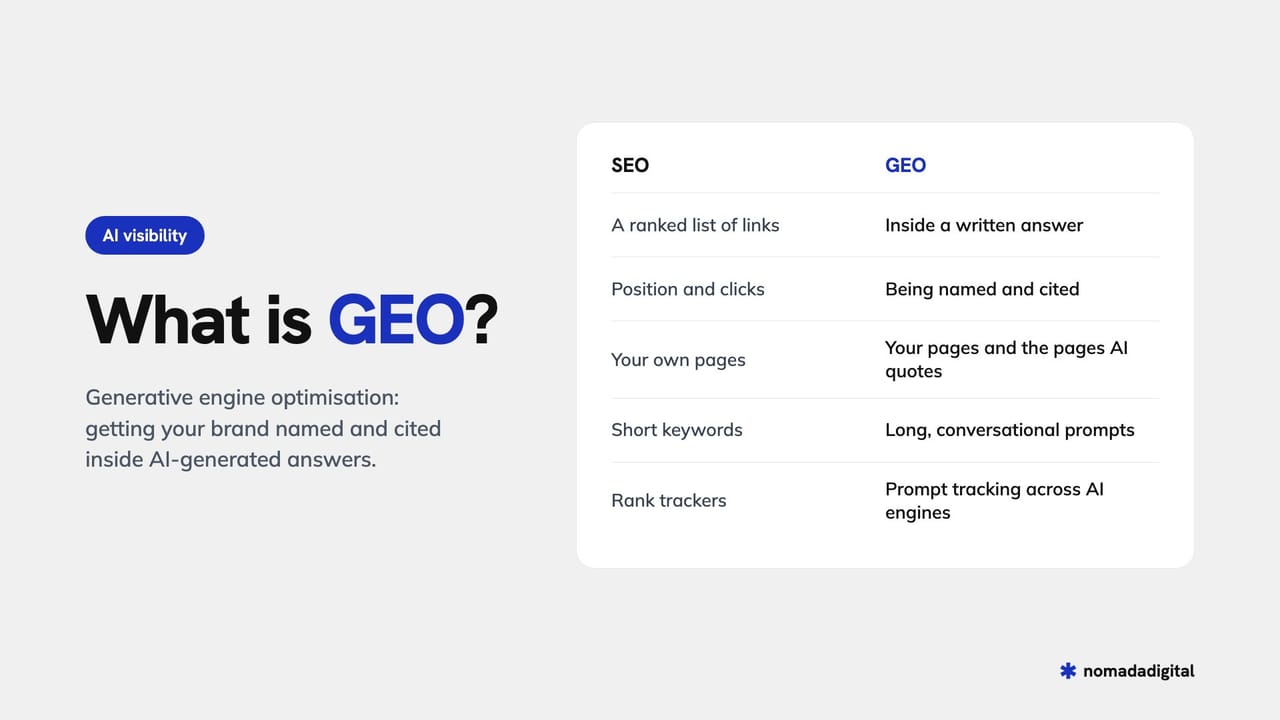
GEO vs SEO: what's actually different
GEO doesn't replace SEO. Most AI answers are built from pages that already rank well in search, so SEO is still the foundation. What changes is where you need to show up and how you measure it.
| SEO | GEO | |
|---|---|---|
| Where you show up | A ranked list of links | Inside a written answer |
| Unit of success | Position and clicks | Being named, being cited, share of answers |
| What you optimise | Your own pages | Your pages and the third-party pages AI quotes |
| Query shape | Short keywords | Long, conversational prompts |
| Measurement | Rank trackers, Search Console | Prompt tracking across several AI engines |
| Volatility | Fairly stable day to day | Answers vary between runs and engines |
The biggest practical difference is the third row. In SEO you mostly work on your own site. In GEO, a large share of the answer is built from other people's pages - listicles, review sites, comparison articles, forums, trade press. If those pages don't mention you, the AI has nothing to work with.
How generative engines decide who to name
AI engines don't hold opinions about who's best. They retrieve pages they trust, then summarise what those pages say. So the question becomes: what do the pages they retrieve say about you?
A few patterns hold across engines:
- Pages that rank get cited. Retrieval leans heavily on search results, so the pages on page one for "best X" are disproportionately the ones quoted.
- Consensus wins. A brand mentioned across several independent sources is named more reliably than one mentioned once.
- Specifics get quoted. Clear claims, numbers, named examples and short definitions are easier to lift into an answer than vague marketing copy.
- Each engine has its own habits. Perplexity cites heavily and visibly. Google AI Overviews leans on Google's own index. ChatGPT mixes search results with what the model already knows. Tracking one engine tells you little about the others.
What GEO work involves
GEO work falls into three buckets.
1. On your own site
- Answer the buying questions directly, in plain sentences, near the top of the page.
- Use clear definitions, comparison tables and FAQs that can be lifted cleanly into an answer.
- Back claims with numbers, named customers and sources.
- Make sure AI crawlers can access the pages that matter.
2. On other people's sites
- Find the pages AI engines cite for your category's buying prompts.
- Get named on them - through editorial placements, link insertions, PR and reviews.
- Create new listicles on niche-relevant sites the engines already trust.
3. Measurement
- Track a fixed set of buying prompts across several engines, daily or weekly.
- Record whether you're named, whether you're cited, and who's named instead.
- Track which pages get cited, because that list is your placement plan.
How to measure GEO
You can't manage what you can't see, and Search Console won't show you AI answers.
Start with a quick manual test. Ask ChatGPT, Gemini and Perplexity "what's the best supplier of what we do for a business like ours?" three different ways, and note who's named. Then make it systematic with an LLM visibility checker, which runs your buying prompts across several engines at once and shows which pages each answer cites.
The metrics worth tracking:
- Mention rate - the share of tracked prompts where you're named.
- Citation rate - the share of answers that cite your pages.
- Share of voice - how often you're named versus named competitors.
- Cited sources - the third-party pages driving answers in your category.
Run prompts more than once. AI answers vary between runs, so a single check is a snapshot, not a trend.
Common GEO mistakes
- Treating it as a separate channel. GEO built on a weak SEO foundation rarely works. The same content and links feed both.
- Only working on your own site. If the pages AI cites are other people's, your site alone can't fix it.
- Measuring one engine. Being named in ChatGPT doesn't mean you're in AI Overviews.
- Chasing hacks. Hidden prompts and keyword-stuffed "AI pages" tend to be ignored or penalised. Engines reward the same thing search does over time: credible sources saying consistent things.
Frequently asked questions
Is GEO the same as AEO?
They overlap heavily. AEO (answer engine optimisation) is the older term, from the era of featured snippets and voice assistants, and focuses on being the direct answer. GEO focuses on generative AI answers, where the engine writes a summary from several sources. Most practitioners now use the terms interchangeably. We cover the difference in more detail in our guide to AEO.
Does GEO replace SEO?
No. Most AI answers are built from pages that rank in search, so SEO is the foundation GEO sits on. GEO adds new targets (being named and cited) and new work (getting onto third-party pages AI quotes).
How long does GEO take to work?
Faster than SEO in some cases. A placement on a page that's already being cited can show up in AI answers within days or weeks. Building broader consensus across sources takes months.
Can you pay to appear in ChatGPT answers?
Not in the organic answer itself. Some engines are testing ads alongside answers, but being named in the answer depends on the sources the engine retrieves.
What does a GEO agency do?
It tracks how AI engines answer your buying prompts, works out which pages they cite, and gets you named on those pages and your own. Look for one that reports a measured share of AI answers naming you, not just rankings. alwayscited is the AI SEO agency and tracking tool built by Nomada Digital for exactly this.
The takeaway
GEO is SEO's next job, not its replacement. The engines still read the web. They just summarise it before your buyer sees it.
So the question to ask is simple: when a buyer asks AI for a recommendation in your category, who gets named - and which pages told the AI to name them?
Find out where you stand. Run a free scan with the alwayscited LLM visibility checker: five buying prompts, four AI engines, about two minutes, no email needed.

Nomada Digital is a B2B SEO and AI search agency. The views here are practitioner-level and based on real client data.