Legal is one of the most competitive sectors in UK search. National firms, claims companies, directories and comparison platforms all bid for the same terms, and a single matter can be worth thousands.
The good news: most law firm websites are still weak on the basics. A firm that gets practice area pages, local signals and authority right can outrank much bigger competitors in the areas that matter to it.
Why law firm SEO is different
It's YMYL. Google treats legal content as "your money or your life", so it holds it to a higher standard of expertise and trust. Anonymous content written by "the team" struggles.
It's regulated. The SRA Transparency Rules require firms to publish price and service information for certain services, including residential conveyancing, probate, employment tribunal claims and some immigration and debt recovery work. Check the current SRA guidance for the full list. Done well, that content is also good SEO.
Search behaviour splits in two. Private client and consumer work (conveyancing, family, wills, PI) is local and urgent. Commercial work (corporate, commercial property, disputes) is national, slower, and decided by a few senior people.
The client often asks AI first. "Best probate solicitors in Birmingham" or "which firms handle shareholder disputes" increasingly gets asked in ChatGPT or answered by Google's AI Overview before anyone clicks.
Practice area pages: where most enquiries start
Each service you want enquiries for needs its own page. "Family law" is not enough. Divorce, child arrangements, financial settlements and cohabitation disputes are different searches from different people.
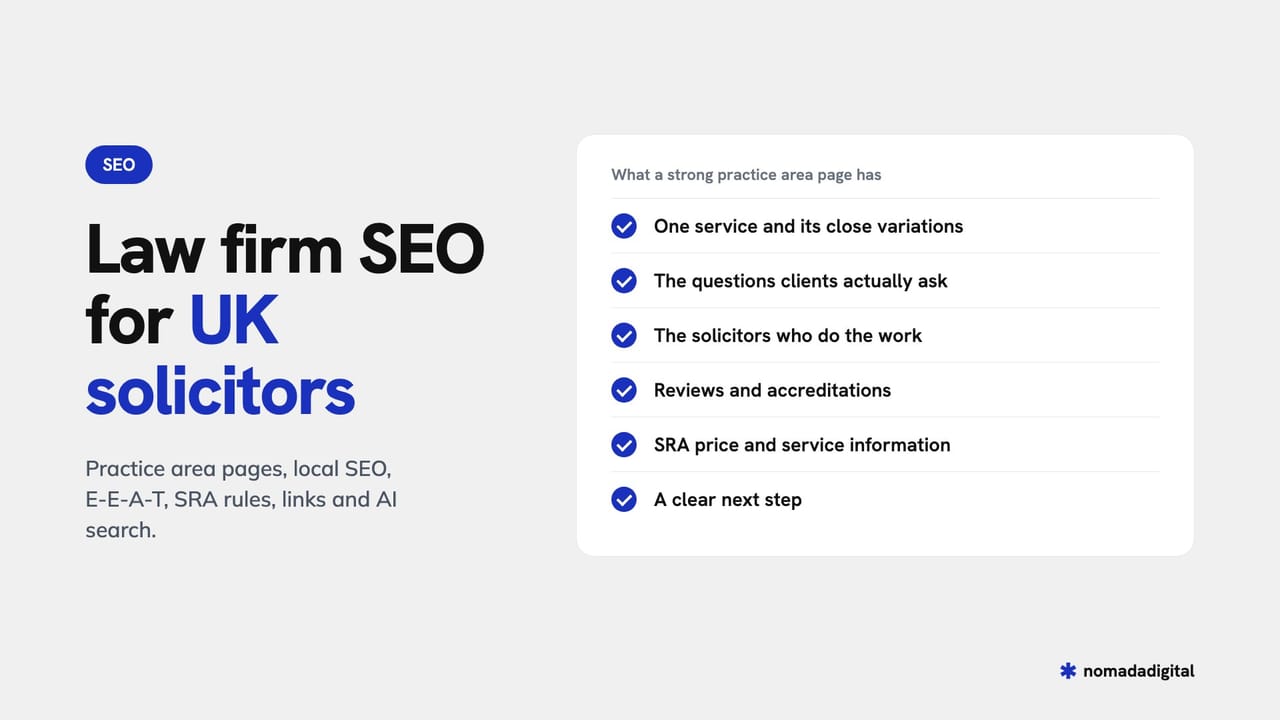
A strong practice area page:
- targets one service and its close variations
- answers the questions clients actually ask - cost, timescales, process, what to bring
- names the solicitors who do the work, with their experience
- shows reviews, case outcomes (where permitted) and accreditations
- includes the price and service information the SRA requires, where relevant
- has a clear next step - a call, a form, a callback
For commercial firms, add sector pages too. A buyer searching "corporate solicitors for tech companies" is a better lead than one searching "corporate solicitors".
Local SEO for high street and regional firms
If your clients come from a town or region, local search is where most enquiries come from.
- Google Business Profile for every office, with the most specific primary category Google offers for your work, real photos, accurate hours and service lists.
- Reviews on Google and specialist platforms such as ReviewSolicitors, requested consistently after matters close.
- Location pages for each office, with genuinely local content - not the same text with the town name swapped.
- Consistent details across the Law Society's Find a Solicitor, legal directories and local listings.
E-E-A-T: show the people behind the advice
Legal content needs a credible author. Give every solicitor a proper profile page - qualifications, admission year, specialisms, accreditations, directory rankings, articles and speaking - and link their content to it.
Firms with Legal 500 or Chambers rankings, Law Society accreditations or panel memberships should make those visible. They're trust signals for clients and for search engines.
Authority: links that law firms can actually earn
Law firms have more link opportunities than most businesses:
- legal directories and rankings
- comment on legal and business news in trade and national press
- guest articles in sector publications your clients read
- local business, charity and community sponsorships
- universities, professional bodies and events
- third-party guides and listicles that rank for your services
Placements on pages that already rank for your practice areas do double duty: they help Google rankings and they're the pages AI answers tend to quote.
Technical basics that still trip firms up
- Slow, script-heavy sites (especially on mobile, where most consumer enquiries start)
- Duplicate location pages and thin service pages
- Old blog posts on outdated law still ranking and confusing visitors
- Missing schema for LegalService, Attorney or Organization, and for FAQs
- Contact forms and call tracking that don't report back to the CRM
AI search for law firms
Clients increasingly ask AI tools for recommendations and explanations. That changes two things.
First, explanatory content needs clear, quotable answers - plain-English definitions, steps and costs near the top of the page.
Second, recommendations in AI answers come largely from third-party sources: directories, reviews, rankings and "best solicitors for X" articles. If those pages don't mention your firm, AI won't either.
You can check where you stand by asking ChatGPT, Gemini and Perplexity who they'd recommend for your main services and locations, or by running a free LLM visibility checker. Our guide to generative engine optimisation explains the mechanics.
Measuring law firm SEO
Rankings and traffic matter, but the number that pays for SEO is enquiries - and ideally instructions.
Track:
- calls and forms by practice area, with call tracking on key pages
- enquiry quality, not just volume (a conveyancing quote request isn't a £50k dispute)
- instructions and fee income from organic enquiries, via your case management system or CRM
- visibility in AI answers for your core services
Set expectations internally. Local consumer work can move in three to four months. Competitive national and commercial terms usually take six to twelve.
Frequently asked questions
How much does SEO for a law firm cost in the UK?
It ranges widely. Small high street firms can start from a few hundred pounds a month with a specialist, while competitive regional and national campaigns typically run from £2,000 to £8,000 a month. Larger multi-office and commercial programmes cost more.
Should a law firm do SEO or Google Ads?
Both, ideally. Google Ads buys immediate visibility on expensive legal terms; SEO builds visibility you don't pay for per click. Many firms use ads for urgent, high-value work and SEO to reduce their reliance on ads over time.
How long does law firm SEO take?
Expect early movement in three to four months for local and long-tail terms, and six to twelve months for competitive practice areas and national terms.
Do SRA rules affect SEO?
Yes. The SRA Transparency Rules require price and service information for certain services, and the SRA's rules on publicity apply to all marketing. Clear, compliant pricing pages also tend to perform well in search.
Can a small law firm outrank national firms?
In its own location and niche, often yes. National firms spread their content thinly across every practice area and town. A local firm with strong practice area pages, reviews and local links can beat them where it matters.
The takeaway
Law firm SEO rewards the basics done properly: a page for every service you want enquiries for, real solicitors behind the content, strong local signals and links you can genuinely earn. Add AI answers to the list, and measure enquiries rather than traffic.
Want to know where your firm is losing enquiries? Book a 30-minute call. We'll show you where you rank against the firms you compete with, on Google and in AI answers.

Nomada Digital is a B2B SEO and AI search agency. The views here are practitioner-level and based on real client data.