Most UK companies entering the US make the same first move: they keep the UK site, change a few prices to dollars, and wait for American buyers to find them. They mostly don't.
Not because the product's wrong. Because Google and the AI engines treat the US as a separate market, with different searches, different competitors and different trusted sources. Winning it takes a plan built for that market.
Start with the decision that's hardest to undo: site structure
You have three realistic options.
| Structure | Example | Pros | Cons |
|---|---|---|---|
| Subfolder | yoursite.com/us/ | Inherits your existing domain authority; one site to maintain | Needs clean hreflang and clear US signals |
| Separate domain | yoursite.com (US) + yoursite.co.uk (UK) | Strongest local signal for each market | Splits authority; two sites to build links to |
| Single global site | yoursite.com, no split | Simplest | Weak US signals; UK spelling and pricing put US buyers off |
For most B2B companies, a subfolder on a .com is the best balance. It keeps the authority you've built, lets you localise properly, and is the easiest to run. A .co.uk domain with a /us/ folder can work, but a ccTLD tells Google "this site is for the UK", which you're then fighting.
If you're on a .co.uk and serious about the US, moving to a .com is often worth it. Plan it as a migration, with redirects mapped page by page.
Get hreflang right, or don't bother localising
Hreflang tells Google which version of a page to show in which country. Without it, Google may show your UK page to US searchers, or treat your two versions as duplicates.
The basics:
- Tag UK pages en-gb and US pages en-us, and point each version at the other.
- Add an x-default for everyone else.
- Every tag must be reciprocal. If the UK page points to the US page, the US page must point back.
- Use self-referencing canonicals on each version, not a canonical from US to UK.
Most hreflang problems are missing return tags and canonicals pointing at the wrong version. Check both in Search Console and a crawler before you launch.
Localise the content, not just the spelling
Changing "optimise" to "optimize" is the easy bit. The bigger differences are what people call things and what they search for.
- Terminology: solicitor vs attorney, invoice finance vs factoring, estate agent vs realtor, CV vs resume, VAT vs sales tax. Get these wrong and you won't rank for the term Americans actually type.
- Buying context: US buyers expect different pricing formats, compliance references (SOC 2, HIPAA, state-level rules) and proof (US customers, US case studies).
- Search volume: a term with 50 searches a month in the UK can have 2,000 in the US, and vice versa. Don't assume your UK keyword list transfers.
Run US keyword research from scratch, using US location settings. Then build US pages around US clusters rather than translating UK pages line by line.
Build US authority
Links from UK sites help your domain overall, but US rankings respond strongly to US relevance. You need mentions and links from sources US buyers - and US search engines - trust.
Good sources:
- US trade publications and industry associations in your sector
- US-focused listicles and comparison pages for your category
- US partners, integrations and resellers
- US podcasts, events and conference coverage
- US review and directory sites relevant to your sector
The pages that rank on US page one for your category's "best X" searches are worth special attention. They're often the same pages US AI answers quote.
Don't forget AI answers, which differ by market
ChatGPT, Google AI Overviews and Perplexity tailor answers by location. A UK buyer and a US buyer asking the same question can get different brands named, built from different sources.
So when you check whether AI recommends you, check from the US as well as the UK. If US answers cite US listicles and trade sites you're absent from, that's your link plan.
Signal that you actually serve the US
Google and buyers both look for evidence that you're a real option in the US:
- USD pricing on US pages
- US phone number and, if you have one, a US address
- US customer logos and case studies
- US time-zone support hours
- US-relevant compliance and security credentials
None of these is a ranking factor on its own. Together they make US pages convert, and convert-friendly pages tend to earn the engagement and links that help them rank.
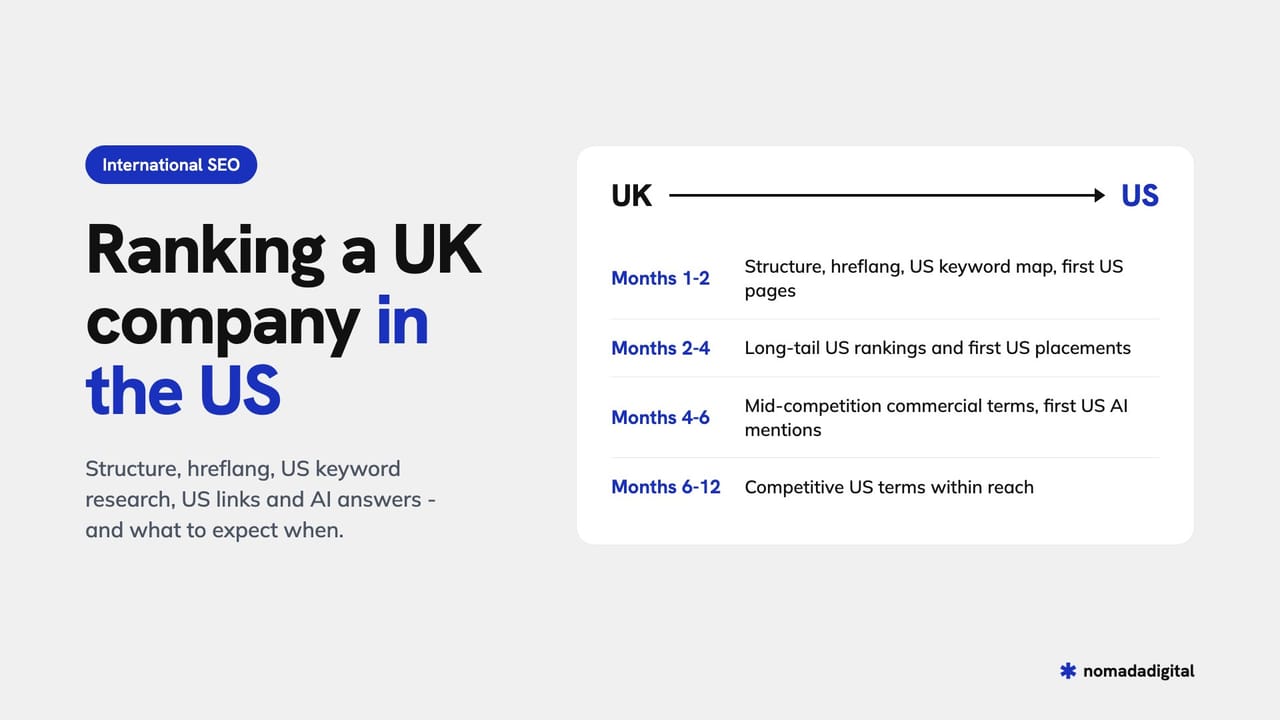
What to expect, and when
| Timeframe | What usually happens |
|---|---|
| Months 1-2 | Structure, hreflang, US keyword map and first US pages live |
| Months 2-4 | US pages indexed and ranking for long-tail terms; first US placements |
| Months 4-6 | Movement on mid-competition commercial terms; first US AI mentions |
| Months 6-12 | Competitive US terms within reach if links and content keep pace |
It can be faster. Neo Agent, a London-based B2B SaaS company, now ranks number one on US Google for terms including "rmm agent" and "psa rmm" (Ahrefs, US, 1 October 2026), with non-brand clicks up around 700%. Vibe Retail moved from outside the top 100 to number one in three months and reached 25% ChatGPT visibility. Both started with US-specific keyword clusters and placements on the US pages the engines already cite.
Common UK-to-US SEO mistakes
- One site, no hreflang. Google picks a version for you, often the wrong one.
- Translating UK pages. US buyers search different terms; a translated page targets keywords nobody uses.
- UK-only links. Your authority grows but your US relevance doesn't.
- Checking rankings from the UK. Use US location settings, or you're measuring the wrong market.
- Ignoring AI answers in the US. If US prompts recommend local competitors, you're off the shortlist before anyone searches.
Frequently asked questions
Do I need a separate website to rank in the US?
No. A /us/ subfolder on a .com with correct hreflang usually works best for B2B, because it keeps your existing authority. A separate domain gives the strongest local signal but splits your link building in two.
Can a .co.uk domain rank in the US?
It can, but it's harder. A .co.uk is a country-code domain, which tells Google the site targets the UK. If the US is a major market, moving to a .com is usually worth the migration effort.
Do I need a US address to rank in the US?
Not for national B2B searches. It helps with trust and conversions, and it matters for local "near me" searches, but national rankings depend far more on content relevance and US links.
How long does it take a UK company to rank in the US?
Typically four to six months for meaningful movement on commercial terms, and six to twelve for competitive ones. Niche B2B categories can move faster, especially with placements on pages that already rank.
Should I hire a UK or a US agency for US SEO?
A US agency knows the market; a UK agency knows your business and your existing site. The best fit is an agency with proof of ranking UK companies in the US specifically. That's what our international SEO agency work is built around.
The takeaway
The US isn't a bigger UK. It's a different market with different searches, different competitors and different trusted sources - on Google and in AI answers.
Get the structure and hreflang right first, research US keywords from scratch, and build presence on the US pages that already rank. Everything else follows from that.
Taking your company into the US? See how our UK to US SEO works, or book a 30-minute call and we'll show you where you stand in US search and US AI answers today.

Nomada Digital is a B2B SEO and AI search agency. The views here are practitioner-level and based on real client data.